He was not feeling right
with the mountain. He had been the first to throw up,
yesterday, at 14,800 feet, and the woman beside him, his
wife and tentmate — a self-described "asphalt neurotic"
whose fashion consciousness had never permitted her to wear
a backpack, not even that ubiquitous little black number
from Prada — had regarded him less with pity than
delight. "The Great Outdoorsman," she said as he wiped his
mouth with a red bandanna. Her idea of a vacation was two
weeks on the C–te d'Azur, not a trek to the roof of
the continent where mankind's evolutionary adventure began.
But hadn't she been a sport so far! Gliding up the trail
as if it were an escalator at Bergdorf's. "Mountain Man,"
she said. "Not!"
And now it was night again, another
camp, another round of aspirin and Tylenol PM and Advil
washed down with Tanzanian tea and iodized water in a
vain effort to quell the headaches. They were all under
orders from the trip leader to keep their urine "clear
and copious." All night he'd hear the Diamoxers jumping
up to drain their bladders, first the buzz of zippers
from the neighboring tents and then some huffing and hopping
and then small Niagaras hitting talus. It was as if they
were camped in a barn full of racehorses. As the moon
rose and spread its cold bone-dust on the glaciers and
the ramparts of the Western Breach, he could feel the
insomnia settling in, the endless run-on sentence of unwanted
wakefulness, his mind stuck on something he'd read in
Joan Didion's book The White Album: "Certain places seem
to exist mainly because someone has written about them.
Kilimanjaro belongs to Ernest Hemingway."
Well, if it did it was obviously on the strength of the
short story "The Snows of Kilimanjaro." To credit a piece
of fiction with the power of eminent domain had seemed
ridiculous at sea level, a misbegotten idea born of one
of Didion's famous Santa Ana migraines, but at 16,000
feet, he wondered if she didn't have a point. It was a
given that aspiring Kili climbers read or re-read the
1936 tale of the famous dying writer who, from a camp
in the shadow of the great volcano, catalogs the stories
he meant to write and contemplates the portents of death
hovering near (buzzards, hyenas) and casts his eyes on
the glaciated summit in the distance, "great, high, and
unbelievably white." Kilimanjaro, the Masai's NgÇje NgÇi,
"the House of God." Where the dying writer's soul was
bound, assuming it wasn't being sent straight to feminist
hell for phallocentric sins. And where the famous Kilimanjaro
leopard, whose ear was clipped and whose picture was taken
before the carcass disappeared, had been found at what
is now called Leopard Point, provoking much wonder about
the animal's motives.
The story had been made into a voluptuously bad movie
in 1952 with Gregory Peck and Ava Gardner, a movie that
managed to load so much philosophical gravitas onto the
enigma of the leopard that the whole business cried out
for a Monty Python parody. Now as he lay on "Hemingway's"
mountain, unsuccessfully drugged and longing for sleep
beside his soundly sleeping wife — who hated backpacking
but who somehow in the space of five days had transmogrified
into Mrs. John Muir — he wondered if the mystery
of the leopard that climbed Kilimanjaro was any more unfathomable
than the mystery of those common house cats that are always
summiting refrigerators. Grander, for sure. Loftier, no
doubt. But any more of a riddle?
Five nights ago, their first in Africa, when they were
en route to their camp on the savanna west of Kilimanjaro,
jouncing in the darkness over what seemed quintessentially
wild and roadless country, a member of the cat family
had flashed in front of the Land Cruiser.
"A cat!" shouted Godwin, the driver.
It was the first game they'd seen, wild Africa incarnate.
But which of the ten cat species was it? A big-eared serval,
out prowling for rats and grasshoppers? An African lynx,
maybe?
"What kind of cat?" he asked the driver.
"Domestic."
Oh. A house cat. Such deflations had shaped the ironic,
where's-the-joke style of his generation, and he wondered
if 50 years hence his contemporaries — all of them
who were connoisseurs of absurdity, at least — would
seem as dated and fatuous as Hemingway's characters: men
and women who appeared now as a bunch of trigger-happy
jackass racists moaning about the "fat on their souls"
while step'n'fetchits named Molo fixed them whiskey sodas
and said, "Yes Bwana, no Bwana, right away Bwana."
Still, if you compared the way Westerners traveled in
East Africa today and the way they did in Hemingway's
time, similarities outnumbered differences. Maybe, in
the distemper of a Didionesque headache, he wasn't being
fair. Hemingway's colonial fools couldn't be any more
blind and self-righteous than Didion herself, who'd seen
fit to give the novelist title to the very signature of
Africa, a mountain first described by Ptolemy back when
the sun circled the earth. And what about the current
crop of cultural chauvinists, this fussy, trip-of-a-lifetime
group of tourists who were tossing and pissing at the
foot of the Western Breach? Weren't they as caught up
in their own fictions about Africa as any generation of
bwanas before them? Weren't they trying to read a country
with eyes clouded by European biases and fantasies, and
European fears, too? Every generation struggling to decipher
its own story has some version of a frozen leopard, some
haunted totem that expresses its unconscious terror, its
perplexity in the face of death.
What genius "The Snows of Kilimanjaro" possessed —
what induced Africa-bound travelers to read it as a matter
of course — lay in its making Kilimanjaro the focus
of a deathbed vision. For all of Africa's Edenic connotations,
the wild country was still presented first as the land
of savage blood-sports — of snapped spines, severed
jugulars, shredded hamstrings, and flyblown eyes. And
it was just this slaughter on the savanna that made Kilimanjaro
so alluring to Westerners on safari, and perhaps even
to Masai souls needing some uncontested spot for a peaceful
afterlife. Those first two nights at 4,000 feet before
the climb began, he had had to squire his wife to the
latrine at 3 a.m. because she was so verklemmt about hyenas,
even though on a warm-up hike they'd seen only a solitary
ostrich and a lot of red ticks. It didn't matter. She
had overdosed on PBS nature documentaries. She was convinced
that all the carnivores of the continent were outside
the tent, honing their teeth on the zipper. But the higher
she got on the mountain, the bolder she became. The redoubts
of Kilimanjaro offered sanctuary from the killing fields
and the curdling night cries.
A buzzard zipped — no, it was just a zipper buzzing,
thank God. He'd been asleep, and realized now he was awake,
and that Alydar and Affirmed had trotted outside with
Secretariat to hose down the rocks with processed Tanzanian
tea. And these photons searing his retina: It was Mrs.
Muir, wearing an argon laser headlamp over her balaclava.
"You were shouting in your sleep, Mountain Man."
"What was I saying?"
"'Aspirin, Molo! Aspirin!'"
Kilimanjaro is hardly terra
incognita. As one of the most famous mountains in the
world, renowned for the marvel of its equatorial ice and
the legend of its leopard and the unforbidding angle of
its slopes, it seems to summon the mountaineer in people
who would otherwise never venture onto mountains. Where
dense stone meets thin air, Kilimanjaro is also famous
for its hardships. Acute mountain sickness in the last
decade has killed an average of ten Kili climbers annually.
There's hardly a penitent who staggers out of the House
of God without vowing never to go back, but then complaining
about the mountain is one of the perverse pleasures of
climbing it.
What's hard to grasp is Kilimanjaro's immensity. It is
one of the largest freestanding mountains in the world,
so massive that its weight measurably depresses the crust
of the earth. It rises to 19,340 feet from a base that
stretches 50 miles along the Tanzania-Kenya border and
in places is more than 25 miles across. It was built by
prodigious extrusions of black rhomb porphyry lava erupting
from faults and fractures in the Great Rift Valley. It
is a geological infant, a scant 750,000 years old, with
two sharply contrasted summits (the now-dormant volcanoes
Kibo and Mawenzi) and the remnants of a third (the collapsed
caldera known as the Shira Plateau).
And yet for all its monumental proportions, its geographic
and psychological conspicuousness, Kilimanjaro is oddly
elusive. This is not simply a matter of the weather, which
often obscures it by midmorning. Even on the clearest
days, Kilimanjaro seems hidden in its own celebrity, shrouded
in the paradoxical fashion of classic places by a veil
of clichës and preconceptions, a million unrevealing images
iterated on beer labels and postcards and "I Climbed Kili"
T-shirts. Something not to be discovered so much as checked
off, bagged, dispensed with; less a mountain than an abstraction
that recedes into the background as one's own experiences
on it rush breathlessly to the fore.
For centuries, to the outside world, Kilimanjaro existed
as a myth. Ptolemy left the first written record of "a
great snow mountain" at a latitude of liquefying heat.
What had been a landmark for Zanzibar traders and slave
caravan masters was still a rumor in Europe until 1849,
when Christian missionary Johann Rebmann's report of a
snow-covered mountain near the equator was published.
Even then, some prominent know-it-alls back at the Royal
Geographical Society in London scoffed at the idea and
patronized the eyewitness as a fool.
Kilimanjaro rebuffed ascents until 1889, when German
climber Hans Meyer battled through deep snow and found
a route on the southeastern flank of Kibo. He called the
high point Kaiser Wilhelm's Peak. (When Tanzania gained
its independence in 1961 the actual summit was renamed
Uhuru Peak, Swahili for "freedom.") Meyer's climb was
his second try. He had been turned back two years before
by an insurmountable rampart of blue ice at around 18,000
feet. Eleven years after that first attempt, he returned
to Kilimanjaro to study its glaciers and was shocked to
discover how much the ice had shrunk back over the crater
rim, a dramatic retreat that has since slowed but not
halted. (Some glaciers described in a 30-year-old climbing
guide no longer exist.)
As the ice melted it released a deluge of tourists. Today
boot traffic on Kilimanjaro has pestled the trails to
a fine powder. Bylines and other moronic personal affirmations
have been scratched into rocks along popular routes. Many
campsites are stripped bare of firewood and poxed with
outbreaks of pink Tanzanian toilet paper. About 12,000
climbers attempted the mountain in 1996, but the number
doesn't tell half the story. You cannot climb without
a local guide, and porters are so cheap to hire, from
$4 to $7 a day, that almost every climber goes up with
a retinue. Which is to say that if you add the staff,
there were upward of 30,000 people walking on the mountain's
trails.
Ninety percent follow what's called the tourist or Coca-Cola
route, which starts at the Marangu Gate, on the mountain's
southeastern flank, and links three bunk-and-kitchen huts
in a five-day, four-night round-trip. Roughly parallel
to Meyer's pioneering ascent, the Coca-Cola route has
been the main way up the mountain almost from the moment
it was established in 1909, but what makes it expeditious
is also what makes it demoralizing: Climbers don't have
time to acclimatize. More than half don't reach the summit,
and for many even getting to the crater rim at 18,650
feet is the most exacting labor of their lives.
Other, less traveled routes follow ridges along the southern
side of the mountain and make use of unequipped huts.
If you go all the way around to the west there is a seldom-used
trail that crosses the desolate Shira Plateau and then
angles up to a high camp at the foot of a dramatic break
in the crater rim, known as the Western Breach. Short
of a technical ascent of one of Kili's glaciers, it is
the most interesting way up the mountain, and it was the
way a group organized by Wilderness Travel — my
wife, Kate, and me included — was planning to go.
We would have the luxury of eight days instead of five
to follow in the footsteps of the leopard.
There were ten of us in all,
six men, four women, under the close supervision of a
29-year-old Tanzanian named Alex Lemunge. Alex had been
to the top of Kilimanjaro 52 times, but this would be
his inaugural ascent as a trip leader, a tricky job that
had previously been handled by white expatriates. Alex
was about six feet tall, with movie-star cheek bones and
eyes the color of old pennies. He had grown up in the
forest, hunting antelope with his father using bows and
arrows and sometimes spears. In the pitch dark when you
could barely see your hand in front of your face, Alex
could read the braille of a game trail with his feet.
For a while he had wanted to become a Catholic priest,
but his seminary studies were interrupted by mandatory
army service and then curtailed for good when he had to
still earn a living after his father died in 1993. But
there was still something of the priest in the mountain
guide. Kilimanjaro was Alex's church, and shepherding
nauseous flocks of bwanas to the shrine of its summit
was his ministry. On a neck chain he wore his wedding
ring and medals of St. Francis, patron saint of animals,
and St. Bernard, patron saint of alpine travelers.
The only wilderness Alex did not seem completely at home
in was the culture of his Western clients, whose conversations
revolved around business deals, modem speeds, mutual funds,
and frequent-flier mileage. But he had been with our herd
since we arrived at Kilimanjaro International Airport,
outside Arusha, and as a student of animals he had been
taking our measure in his low-key way, trying to anticipate
who might have problems on the mountain, who might cause
them. With a clipboard checklist, he reviewed our equipment,
the layers of long underwear, the gaiters, hats, and gloves
that seemed incongruous in the heat of the savanna. He
went over the itinerary. He said we would all be hiking
together, at the pole pole, "slowly, slowly," pace that
is the secret of success on Kilimanjaro and the mantra
of all the mountain guides. Bwana was always in a rush.
"If you can't talk while you're hiking, you're walking
too fast," Alex said. He promised that we would all have
headaches and feel nauseous and wouldn't want to eat,
but it was our job to eat, and to drink water. "We'll
see people puking the entire trip," he said with a strange
enthusiasm, as if the prospect held a special glamour.
Alex's English (his fourth language, after Swahili, Chagga,
and Masai) was fluent, full of soft, rolling cadences;
when he pronounced the word "absolutely" he sounded a
little like Arnold Schwarzenegger. Ab-so-loot-ly. At times
it took some doing to decode his accent. During the preclimb
briefing, Alex advised that if we wanted to "party" we
shouldn't just go off into the woods alone; we should
tell someone. "So please, if you have to party, let someone
know," he said. I looked around at my fellow climbers.
Norman, a New York photographer, was 28; Christine, an
accountant from Bermuda, was 37. OK, maybe they had come
to Africa to party. They were young, like Mrs. Muir; they
had brain cells to kill. But what about Paul,
a lawyer from Portland, and his wife, Sharon, a real estate
agent, and Bob, who had just sold his document
storage company in Chicago, and Stephen, a management
consultant from Palo Alto? They were in their fifties.
And Lina and Cesare, two Italian scientists from Oakland,
were in their sixties! It had probably been 20 or 30 years
since they'd all worn togas and danced with lamp shades
on their heads.
Frankly, everyone was mystified by Alex's preoccupation
with our supposed desire to party and wondered if it bespoke
some grave cultural misunderstanding. Finally it dawned
that when Alex was saying "party" he was meaning "potty,"
and that this was his charmingly euphemistic — albeit
bizarrely infantilizing — way of explaining how
we should handle the call of nature.
After the prelude on the savanna, we piled into three
trucks and drove for two hours on a red dirt road that
climbed out of the tick-ridden grasslands and into the
foothills of Kilimanjaro. At last, at 7,000 feet, the
road quit, and where you might expect to find only the
silence and solitude of the deep forest that encircles
the mountain, a small army of Tanzanians had been mobilized
in a clearing — cooks, guides, porters, milling
around, smoking, drinking tea. Cesare shook his head.
"Three cooks, five guides, and 33 porters for ten stupid
tourists," he said with brio. I knew what he meant, and
tried to explain to the Asphalt Neurotic that any self-respecting
Mountain Man used to carrying his own stuff would have
compunctions about a horde of servants retained on his
behalf; she would have none of it.
The trucks were unloaded, and our gear was quickly stuffed
into waterproof green bags that were the size of small
dumpsters and were equipped with primitive, vicious-looking
shoulder straps. Alex introduced us to Remy Damian, the
head guide, a compact, rheumy-eyed grandfather of eight
who was all of 45 years old. Remy had hired the porters
and appointed the assistant guides, one of whom was his
24-year-old son-in-law Poncian, who wore a rakish black
beret. Remy served on the rescue team in Kilimanjaro National
Park, and he apparently had no trouble at altitude despite
a pack-a-day addiction to Sportsman cigarettes. Cigarettes,
he joked, were his Diamox.
I asked him how many times he'd climbed Kilimanjaro.
He shuddered, as if it were an especially difficult math
problem. "Too many times to count," he said. "Maybe three
or five hundred times."
"How many times have you used that joke about cigarettes
being Diamox?"
"Many times," he said, smiling slyly.
On command from Alex, we shouldered our pathetically light
daypacks and filed into the forest. The protocol had been
explained. Alex would set the pace at the front (carrying
his own tent and sleeping bag), and Remy and his assistants
would bring up the rear, waiting on any stragglers, ready
to attend should some poor sap pull off the trail and
hurl breakfast. I took a last look at the trucks that
would not be seen again until our exit at Mweka Gate,
on the south side of the mountain. Eight days, 37 miles:
a modest distance, and no true measure of the work ahead.
We were bound for the Shira Plateau on an old poachers'
trail that Wilderness Travel now used regularly for its
Kilimanjaro expeditions. Alex set a pace that was only
slightly faster than a funeral cortege. We weren't 20
minutes underway when the cry went up from the rear, "Porters!"
and we stepped aside to let the battalion through. "Jambo!
Jambo!" the porters said as they passed. They were moving
twice as fast and had worked up a sweat. Each porter had
his own style. Some actually used the cruel shoulder straps
and hauled the weight on their backs. Others leaned forward
with the straps around their foreheads and the bags slung
over their necks. Some dispensed with the straps altogether
and hiked along with hands in pockets, their burdens expertly
balanced on their heads.
Around midday we came to a spot on the trail where a
camp table was laden with a spread of breads, cheese,
salami, sliced passion fruit, oranges, and avocados.
"Lunch, guys. Let's eat," said Alex, inviting us to sit
down. Sit? Eat? EAT? While sitting? Could anyone sit and
eat when the trailside supermarket seemed so obscenely
lavish? Mountain Man was overcome with guilt to think
that the Tanzanian porters, who were lugging lanterns,
kerosene, black-bottom kettles, a radio, a mess tent,
six dome tents, firewood, crates of fresh carrots, onions,
tomatoes, oranges, hard-boiled eggs, bricks of cheese,
ten sleeping bags, and ten full-length sleeping pads,
were also carrying a dining room table and ten canvas
stools so that he, Bwana Boy, could have something to
plant his fat ass on after the hard work of daypacking
a pair of binoculars, some M&M's, and a light jacket.
(Oh, don't forget the two water bottles.) Chairs! So he
could take a load off his feet, which were snugly encased
in $200 boots, while Molo & Company padded around
in flip-flops. The table lacked for nothing but whiskey
and soda.
Unable to bring myself to sit on the camp stools, I airily
announced that I would squat on the ground like the cooks
who had set out the lunch and the guides who were waiting
to finish what the clients couldn't eat. Squat I did.
Meanwhile my fellow climbers attacked the groaning board
with consciences evidently clear. They piled bread and
fruit and cheese onto plates, they carried their heaping
portions over to the camp chairs, and they eased their
keisters into the seats, sighing and clucking as if their
rest were hard-won and richly deserved. Gosh, the seats
did look awfully comfortable... I began to wonder what
I was trying to prove by a show of phony solidarity with
the chairless class. The social equation in place was
tried and true, and despite its obnoxious colonial overtones,
the easiest thing — the polite thing, probably —
was to go along with it. Make a sandwich, sit down, and
shut up. Besides, this infernal squat was killing my knees.
Climbing Kilimanjaro is the
climatic equivalent of a trip from the equator to the
Arctic. We spent the night in the forest under a giant
podocarpus tree, listening to colobus monkeys and the
haunting, liquid notes of the tropical boubou. We hit
the trail the next morning at around eight — or
two o'clock, as the Chagga would say, because they only
begin to count the day's hours after the sun rises, and
the night's after it sets. Norman was already in full
form. He had gotten his hands on a phrase book and from
the back of the line insisted on shouting sentences of
traveler's Swahili to Alex at the front, taking special
delight in the section reserved for medical problems.
"Alex, drop your pants."
"Alex, give me a urine sample."
If anything could have induced Alex to increase the pace,
this was it, but he forbore patiently, and continued pole
pole.
Abruptly the gloom of the forest gave way to the heath
with its cypress shrubs and feathery stands of white-flowered
heather. The night before, in the moisture-laden air of
the forest, we had been shivering. Now we were exposed
to the persecution of the sun. To the south, the foothills
of Kilimanjaro tapered into dusty wheat-colored plains.
Alex spotted a quartet of eland with his naked eye. The
dun-colored animals were picking their way across a draw
more than a mile off, and even with binoculars they were
hard to see. We dropped over the side of a ravine and
broke for lunch in a shadeless creek bottom. I was too
bushed to stand up for the chairless class and took a
seat and drank off three bowls of mushroom soup.
Leaving the dishes for the staff, we followed Alex up
a steep hill and then breasted a long, low-angled ridge,
one of the great lava rivers that tumble down from the
Shira Plateau. Near the top, we began to contour around
the long shoulder of the caldera's rim. At around three
that afternoon, after six hours on the trail, we crossed
a divide and saw the top of Kilimanjaro in the distance,
an eerily isolated, forbiddingly foreshortened dome of
glaciers and rust-red rock looming over the windy moors.
We camped that night on the dusty plain at 11,300 feet.
It was bitterly cold, and a biting wind harried the tents.
The sight of the mountain from afar seemed to have awakened
some lurking insecurities among the group. Mrs. Muir whispered
that one of the drawbacks of hiking all bunched up was
having to listen to other peoples' conversations. We were
traveling with some major chatterboxes. Alex had said
if you couldn't talk while hiking, you were walking too
fast, but was that to say chit-chat was mandatory? It
was hard to hear your own thoughts for all the talk, much
less the silence of the wild. I asked Remy how to say
"no noise" in Swahili.
"Si taki kelele," he said.
But of course people were chattering because they were
nervous. They were psyched-out. The air was getting thin.
They couldn't bathe. Their digestion was disturbed. Their
spirits were flagging. To the Chagga tribe, who thought
Kilimanjaro was crowned with a baffling kind of silver
that melted in your hand, the mountain was guarded by
spirits who would inflict terrible pain and chills on
anyone foolish enough to venture too high.
That first night on the Shira Plateau, Bob began to show
the wear of nonstop partying. Norman had overdosed on
sun and at dinner poked listlessly at a pancake before
crawling into his tent. Cesare and Lina, who earlier had
been cheerfully bickering about what you could properly
conclude from per capita changes in world energy consumption,
had no zest left for debate. Sharon's heart was
racing and she couldn't catch her breath; she'd begun
to panic that she should be taking Diamox. I crept immediately
into my sleeping bag because my head felt like a bad piece
of taxidermy. When Mrs. Muir came back from the mess tent
a while later, she said, "It's doom and gloom in there.
Sharon was saying, 'Maybe it's time for plan B.'"
Alex, who at supper had taken it upon himself to serve
us the lentil soup and the rice and vegetables, could
see morale hemorrhaging. He pointedly sounded each of
us out, offering advice and encouragement, reassuring
us that nausea and fatigue were normal. Drink more water,
he said. I wasn't taking Diamox, but I was in the barn,
matching the other horses quart for quart. At ten. At
12. At two. At four. Clear and copious, like the stars
I saw while shivering half-naked in the wind, on that
desolate plain, under Kili's starlit silhouette, which
suddenly seemed like no sanctuary at all, but an austere,
unlikely land fit for souls, perhaps, but certainly not
for bodies.
By the next morning when we set out for our camp on the
far side of the Shira Plateau, the hemorrhage in morale
had been stanched. "Si taki
kelele," Remy said as I picked up my hiking stick.
The camp was perched on a bluff just under 13,000 feet.
It had been known as Shira II but had been renamed Fischer's
Camp after Scott Fischer, the American guide who died
on Everest in May 1996. He had been partners with Wesley
Krause, the American climber who owned the local branch
of Wilderness Travel. They had made the second ascent
of Kili's famous Breach Icicle together, and Fischer had
led a number of trips up the mountain, including a fund-raiser
for CARE four months before he died. On a rock at the
back of the camp, Krause had placed a plaque bearing Fischer's
name and some sentimental words about reincarnating as
a mountain. In and of itself the memorial was touching
and not at all conspicuous. And yet it seemed out of place,
part of the colonial tradition that for so many centuries
and in so many more egregious ways had imposed itself
on Africa. If Alex Lemunge were to die taking a group
up the Grand Teton, what would be the chance of a plaque
in his memory adorning a rock somewhere on that mountain?
The next day we had 1,800 or so feet to climb, close
under Little and Great Penck Glaciers, hulking arms of
the Northern Icefield that occupied the summit a mile
above us. But we weren't climbing, really; we were just
endlessly plodding over some giant's earth, like ants
marching up the roof of the King Dome. There was nothing
in the monotony to unsnag my thoughts from the stuck-record
snippets of song or the ineradicable imagery of weird
dreams psychotically enhanced by antimalarial drugs. But
suddenly I was veering off the trail, was doubled over,
and everything was running in reverse, and I was reconsidering
— oh, never mind what. Remy and one of the assistant
guides darted up, and Mrs. Muir too, concerned at first,
and then amused, and then oddly solidified in her new
status as Not the First to Hurl.
"Mountain Man!" she said, and so forth.
She wasn't exactly perishing with happiness the next
day, when we toiled up the switchbacked slope en route
to the Arrow Glacier Camp, named for a vestigial ice floe
at the junction of trails coming from the east and the
south. We were using the one breath-one step technique
that Alex had demonstrated, and it took four hours to
make the climb up to 16,000 feet, where the tents were
pitched near a snout of dirty ice. And neither was Mrs.
Muir clamoring for the optional afternoon hike "to study
the unique flora and fauna," which had been advertised
in the trip brochure. In fact, all the bwanas passed on
all the optional afternoon hikes. Something seemed cruelly
gratuitous in the very concept of optional afternoon hikes.
Better to advertise the optional afternoon see-if-you-can-stand-in-front-of-your-tent,
or the optional see-if-you-can-limp-over-to-the-party-hole-after-dinner.
Above our tents, framed by ice-plastered cliffs, lay
the pitched rubble of the Western Breach. We were camped
in what would be an avalanche run-out on a mountain with
a snow load, and Alex informed us that there was some
danger of rockfall. One stretch of the slope above was
known as the Bowling Alley for all the stones that came
rolling down. If we heard the cry of jiwe! ("rock") or
mawe! ("rocks") we were supposed to dash from our domes
to the lee of an abutment. Given how farfetched were the
prospects of hearing some unfamiliar Swahili over the
wind in the middle of the night, and then of jumping up
when sitting was a challenge, and then of wriggling out
of the tent ... well, I just lumped the whole Keystone
drill in with the optional afternoon hikes.
The group turned in early, as we had most nights when
there was nothing else to do. Sharon was not looking
well. Bob's face was pale and drained. My head
hurt like hell, and shouting for aspirin in some hypnagogic
fantasy only made it worse. A night at Arrow Glacier Camp
put a new twist on Hemingway and Kilimanjaro. If the mountain
belonged to Super Bwana, maybe it was by default. No one
else wanted it.
One step, one breath: up the
debris of the shattered cliffs, up a faint zigzag path
stitched in the talus. Don't look up. Don't look ahead.
Not until that morning on the Western Breach had he felt
right with the mountain. It was almost like climbing,
toiling up the talus past mahogany cliffs and orca-like
patches of snow. And then there was the marvelously metaphorical
name of the Western Breach itself, which seemed to bespeak
not just a break in the crater of Kilimanjaro, but the
rupture with nature itself, the European mind's break
from the nature of its own body. Or perhaps the break
from because-I-said-so authority, which released the Enlightenment
genies of experimental science and rationalism and toppled
the priests that had held sway for centuries in the Houses
of God. His fellow climbers had come from societies created
by the Western breach, societies with the hubris to seek
mountaintops and the technological ingenuity to make Gore-Tex
and internal-frame packs and binoculars that could highlight
elands at 1,500 yards.
But in some ways what made Africa and Kilimanjaro so
beguiling was the glimpse of life such as it might have
been before the Western breach. Bwana could weigh what
had been lost when the West marked out its course. "The
deepest passion of the Western mind," Richard Tarnas has
written in his history of Western thought, "has been to
reunite with the ground of its own being." If, as it seemed,
there was a wound in the image of a breach, wasn't it
also possible that here in Africa, the actual primeval
ground of being, lay the possibility of mending it? Oh,
Christ, he was starting to sound like Gregory Peck in
The Snows of Kilimanjaro.
Aptly he found himself swerving off the trail and throwing
up again, sorry for the people behind him. Pole
pole hiking in a tight group was no fun when a great
outdoorsman was hurling. Lina's Avocet watch said they
were at around 17,000 feet. They had cleared the Bowling
Alley without mishap and had begun to thread their way
up an intricate buttress, at times having to use their
hands to clamber up small cliffs. There were airy drops,
and the landscape was so interesting he forgot how much
his head was hurting. The sweet miserable work of one
breath, one step was a kind of meditation in which the
mind didn't brood about the past or fret about the future,
but was here, now, completely immersed in the only eternity
it could know.
After eight hours and 2,700 feet of climbing, they reached
the crater rim. The soil was soft and devoid of life,
and the midafternoon light gleamed in the white-blue ramparts
of the Furtwangler Glacier. The glacier was sprawled on
the ground like an iceberg on a gray-brown sea. They crunched
across a snowfield. It was a 45-minute walk to the Crater
Camp, at 18,500 feet in the lee of Uhuru Peak. Oh! He
found himself hurling again but was pleased to have company;
Christine had pulled over and shifted into reverse as
well. All of them crawled into their tents and went down
like scythed grass.
In the morning the crater floor was white with rime and
the water bottles were blocks of ice. They started up
switchbacks for the final 800 feet to the summit. One
breath, one step.
He had been prepared to find nothing special at the top,
to get up there and report back with the customary boilerplate
about the anticlimax of high points. He had been prepared
to scuff the dirt and gulp the air in the House of God
and to find things that only science could compass or
explain. Or mundanely human things. The aluminum summit
strongbox with the log of beggared remarks: "Awesome."
"Crying." "Once in a lifetime." "Seventy years old!" He
had been prepared to unveil the myths that were manufactured
when conceptions of a place were formed in a vacuum. He
had not expected to find souls, but rather just more of
the same. As below, so above, albeit "above" was colder
and had less oxygen. And having stood for photographs
in the ostensible House of God, having traversed its windswept
naves and transepts, he thought he would be qualified
to dismiss the quaint superstitions of the Masai and to
mock the sentimental eschatology of Super Bwana and his
fictional stand-in.
And yet up there, as high as you could go on the continent
where the hominid's story began, it suddenly seemed to
him that he was repeating the mistake of those scientific
materialists who carefully weighed the body at the moment
of death to see if they could assay the mass of the departing
soul and then, finding nothing, concluded that souls did
not exist. It seemed to him that his premises had been
as stupidly literal as theirs. Did the disk that would
hold his story about climbing Kilimanjaro weigh any more
than a blank disk fresh out of the box? What if the soul
was a pattern of information? (And all you had to do was
press F10 to save it?) The silence of the mountain was
stealing over him now like a sacrament summoning presences
unseen. Perhaps the summit of Kilimanjaro was indeed a
holy place, an exalted promised land that one might hope
for, or venerate, or look up to from thousands of feet
below. A place a leopard might like to die. It seemed
to him that he should not try to describe it and that
it could not be truly described except from afar, except
as a possibility, a place one never reaches. It had been
desecrated with enough description and inscription already,
and nothing said about it, or written on it, or extracted
from it could ever convey the strange and enduring power
of its covenant.
Oh, molo, it was terrible to
see how the spirit leaves, not in some fancy-pants transit
of the soul, but in the trial of the body, in a marinade
of lactic acid and microruptures in the quadriceps. When
we had finished on the summit, when we had taken all the
class pictures and shaken hands and shivered in the mists
that boiled out of the inner crater, we started down,
shuffling east along a gentle ridge, and then a hard right
at Stella's Point, where the descent began in earnest.
Down and down and down, plunging in giant steps on loose
gray rock and sandlike soil, down one thousand feet, then
two, then three, four, five. We were strung out along
the mountain, not hiking pole pole as a group. I was with
Norman and Kate and Remy's son-in-law Poncian in his black
beret. We made good time, arriving almost an hour before
the others at Barafu Hut, about a mile below the summit.
Barafu was perched on a dry, desolate ridge. Last year
a woman searching for the latrine at night walked off
the cliff and fell to her death.
The three of us were off first after lunch, accompanied
by Poncian. We tumbled out of the bleak rock realm into
the moorlands. Clouds engulfed the ridge. A train of porters
cantered past, not fighting gravity but letting the relentless
declivity pitch them forward. Six thousand feet. Seven
thousand feet — more than the distance from the
North Rim to the floor of the Grand Canyon. It was terrible,
Molo. I had never come down so far; I could feel myself
weakening, my legs getting rubbery. I should not have
scoffed at my wife's twice-a-week sessions lifting weights
and doing lunges with a trainer. Eight thousand feet.
I staggered and had to stop. Rest. Walk. Rest. I was resting
more than walking, and we had more than a thousand feet
to go. Suddenly my legs folded up like a couple of Swiss
Army knife attachments. Poncian caught me as I sank. He
put his arm around my waist; I laid mine on his shoulder,
and we went down the last 800 feet in tandem. It was strangely
intimate to have him support half my weight, and unexpectedly
hard work, too, made harder by the shame I felt in needing
help, and by my anxiety, which was heightened by the land
itself — wild Africa — where the oldest law
decreed the weak and lame were first to die. I saw the
worry on the face of my wife, who trailed behind beset
no longer by hyena frights but by visions of one day having
to push her husband around in a wheelchair.
The rest of the group caught up. Christine and Steve
and Paul and even Sharon, still wasted by altitude.
The light was starting to fade. Would we make Mweka Camp
by nightfall? Bob passed by, offering us his flashlight.
Only Lina and Cesare were still behind us. It was painful
to think I might not get off Kili ahead of a pair of scientists
qualified for AARP discount vitamins. Speed it up, Poncian!
At last we came to a stretch of flats, and I was able
to walk unaided and then blissfully to climb the final
yards up to our camp for the night and to collapse on
a patch of ground at 9,850 feet in the giant heather,
more than 9,000 feet below the summit. I wanted nothing
so much as a whiskey and soda. Cesare and Lina arrived
20 minutes later — last, but self-powered.
Neither a bottle of Advil nor a night of the deepest
sleep could save me from the rigors of the morning. It
was 3,500 more feet down to the park gate, where the deliverance
of motor vehicles awaited. There was no contest about
who would finish last today. My left knee was badly swollen,
and the trail through the forest was a track of treacherous,
tumbling mud and roots. I leaned heavily on my walking
stick, poling along with my torso bent at a right angle.
Mrs. Muir said I looked like a gondolier on a river of
mud. Maybe she had been right: Gimping toward rehab, I
was in no position to quarrel with any plan that featured
two weeks on the C–te d'Azur. Hike high and far
enough, Molo, and the soul that supposedly seeks everlasting
rest on mountaintops will say, "To hell with death and
transfiguration!" It wants nothing but another chance
to make a go of it down low — to see what it can
know of heaven where life abides, in the body's tender
house, its only certain home.
Chip Brown is a frequent contributor
to Outside. He's currently
at work on a book about alternative medicine, to be published
next fall by Putnam Riverhead.





 What genius "The Snows of Kilimanjaro" possessed —
what induced Africa-bound travelers to read it as a matter
of course — lay in its making Kilimanjaro the focus
of a deathbed vision. For all of Africa's Edenic connotations,
the wild country was still presented first as the land
of savage blood-sports — of snapped spines, severed
jugulars, shredded hamstrings, and flyblown eyes. And
it was just this slaughter on the savanna that made Kilimanjaro
so alluring to Westerners on safari, and perhaps even
to Masai souls needing some uncontested spot for a peaceful
afterlife. Those first two nights at 4,000 feet before
the climb began, he had had to squire his wife to the
latrine at 3 a.m. because she was so verklemmt about hyenas,
even though on a warm-up hike they'd seen only a solitary
ostrich and a lot of red ticks. It didn't matter. She
had overdosed on PBS nature documentaries. She was convinced
that all the carnivores of the continent were outside
the tent, honing their teeth on the zipper. But the higher
she got on the mountain, the bolder she became. The redoubts
of Kilimanjaro offered sanctuary from the killing fields
and the curdling night cries.
What genius "The Snows of Kilimanjaro" possessed —
what induced Africa-bound travelers to read it as a matter
of course — lay in its making Kilimanjaro the focus
of a deathbed vision. For all of Africa's Edenic connotations,
the wild country was still presented first as the land
of savage blood-sports — of snapped spines, severed
jugulars, shredded hamstrings, and flyblown eyes. And
it was just this slaughter on the savanna that made Kilimanjaro
so alluring to Westerners on safari, and perhaps even
to Masai souls needing some uncontested spot for a peaceful
afterlife. Those first two nights at 4,000 feet before
the climb began, he had had to squire his wife to the
latrine at 3 a.m. because she was so verklemmt about hyenas,
even though on a warm-up hike they'd seen only a solitary
ostrich and a lot of red ticks. It didn't matter. She
had overdosed on PBS nature documentaries. She was convinced
that all the carnivores of the continent were outside
the tent, honing their teeth on the zipper. But the higher
she got on the mountain, the bolder she became. The redoubts
of Kilimanjaro offered sanctuary from the killing fields
and the curdling night cries. As the ice melted it released a deluge of tourists. Today
boot traffic on Kilimanjaro has pestled the trails to
a fine powder. Bylines and other moronic personal affirmations
have been scratched into rocks along popular routes. Many
campsites are stripped bare of firewood and poxed with
outbreaks of pink Tanzanian toilet paper. About 12,000
climbers attempted the mountain in 1996, but the number
doesn't tell half the story. You cannot climb without
a local guide, and porters are so cheap to hire, from
$4 to $7 a day, that almost every climber goes up with
a retinue. Which is to say that if you add the staff,
there were upward of 30,000 people walking on the mountain's
trails.
As the ice melted it released a deluge of tourists. Today
boot traffic on Kilimanjaro has pestled the trails to
a fine powder. Bylines and other moronic personal affirmations
have been scratched into rocks along popular routes. Many
campsites are stripped bare of firewood and poxed with
outbreaks of pink Tanzanian toilet paper. About 12,000
climbers attempted the mountain in 1996, but the number
doesn't tell half the story. You cannot climb without
a local guide, and porters are so cheap to hire, from
$4 to $7 a day, that almost every climber goes up with
a retinue. Which is to say that if you add the staff,
there were upward of 30,000 people walking on the mountain's
trails.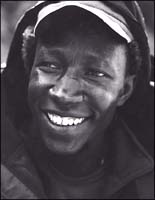 On command from Alex, we shouldered our pathetically light
daypacks and filed into the forest. The protocol had been
explained. Alex would set the pace at the front (carrying
his own tent and sleeping bag), and Remy and his assistants
would bring up the rear, waiting on any stragglers, ready
to attend should some poor sap pull off the trail and
hurl breakfast. I took a last look at the trucks that
would not be seen again until our exit at Mweka Gate,
on the south side of the mountain. Eight days, 37 miles:
a modest distance, and no true measure of the work ahead.
On command from Alex, we shouldered our pathetically light
daypacks and filed into the forest. The protocol had been
explained. Alex would set the pace at the front (carrying
his own tent and sleeping bag), and Remy and his assistants
would bring up the rear, waiting on any stragglers, ready
to attend should some poor sap pull off the trail and
hurl breakfast. I took a last look at the trucks that
would not be seen again until our exit at Mweka Gate,
on the south side of the mountain. Eight days, 37 miles:
a modest distance, and no true measure of the work ahead.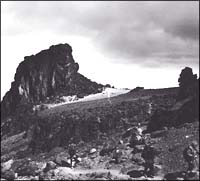 Not until that morning on the Western Breach had he felt
right with the mountain. It was almost like climbing,
toiling up the talus past mahogany cliffs and orca-like
patches of snow. And then there was the marvelously metaphorical
name of the Western Breach itself, which seemed to bespeak
not just a break in the crater of Kilimanjaro, but the
rupture with nature itself, the European mind's break
from the nature of its own body. Or perhaps the break
from because-I-said-so authority, which released the Enlightenment
genies of experimental science and rationalism and toppled
the priests that had held sway for centuries in the Houses
of God. His fellow climbers had come from societies created
by the Western breach, societies with the hubris to seek
mountaintops and the technological ingenuity to make Gore-Tex
and internal-frame packs and binoculars that could highlight
elands at 1,500 yards.
Not until that morning on the Western Breach had he felt
right with the mountain. It was almost like climbing,
toiling up the talus past mahogany cliffs and orca-like
patches of snow. And then there was the marvelously metaphorical
name of the Western Breach itself, which seemed to bespeak
not just a break in the crater of Kilimanjaro, but the
rupture with nature itself, the European mind's break
from the nature of its own body. Or perhaps the break
from because-I-said-so authority, which released the Enlightenment
genies of experimental science and rationalism and toppled
the priests that had held sway for centuries in the Houses
of God. His fellow climbers had come from societies created
by the Western breach, societies with the hubris to seek
mountaintops and the technological ingenuity to make Gore-Tex
and internal-frame packs and binoculars that could highlight
elands at 1,500 yards. The three of us were off first after lunch, accompanied
by Poncian. We tumbled out of the bleak rock realm into
the moorlands. Clouds engulfed the ridge. A train of porters
cantered past, not fighting gravity but letting the relentless
declivity pitch them forward. Six thousand feet. Seven
thousand feet — more than the distance from the
North Rim to the floor of the Grand Canyon. It was terrible,
Molo. I had never come down so far; I could feel myself
weakening, my legs getting rubbery. I should not have
scoffed at my wife's twice-a-week sessions lifting weights
and doing lunges with a trainer. Eight thousand feet.
I staggered and had to stop. Rest. Walk. Rest. I was resting
more than walking, and we had more than a thousand feet
to go. Suddenly my legs folded up like a couple of Swiss
Army knife attachments. Poncian caught me as I sank. He
put his arm around my waist; I laid mine on his shoulder,
and we went down the last 800 feet in tandem. It was strangely
intimate to have him support half my weight, and unexpectedly
hard work, too, made harder by the shame I felt in needing
help, and by my anxiety, which was heightened by the land
itself — wild Africa — where the oldest law
decreed the weak and lame were first to die. I saw the
worry on the face of my wife, who trailed behind beset
no longer by hyena frights but by visions of one day having
to push her husband around in a wheelchair.
The three of us were off first after lunch, accompanied
by Poncian. We tumbled out of the bleak rock realm into
the moorlands. Clouds engulfed the ridge. A train of porters
cantered past, not fighting gravity but letting the relentless
declivity pitch them forward. Six thousand feet. Seven
thousand feet — more than the distance from the
North Rim to the floor of the Grand Canyon. It was terrible,
Molo. I had never come down so far; I could feel myself
weakening, my legs getting rubbery. I should not have
scoffed at my wife's twice-a-week sessions lifting weights
and doing lunges with a trainer. Eight thousand feet.
I staggered and had to stop. Rest. Walk. Rest. I was resting
more than walking, and we had more than a thousand feet
to go. Suddenly my legs folded up like a couple of Swiss
Army knife attachments. Poncian caught me as I sank. He
put his arm around my waist; I laid mine on his shoulder,
and we went down the last 800 feet in tandem. It was strangely
intimate to have him support half my weight, and unexpectedly
hard work, too, made harder by the shame I felt in needing
help, and by my anxiety, which was heightened by the land
itself — wild Africa — where the oldest law
decreed the weak and lame were first to die. I saw the
worry on the face of my wife, who trailed behind beset
no longer by hyena frights but by visions of one day having
to push her husband around in a wheelchair.